

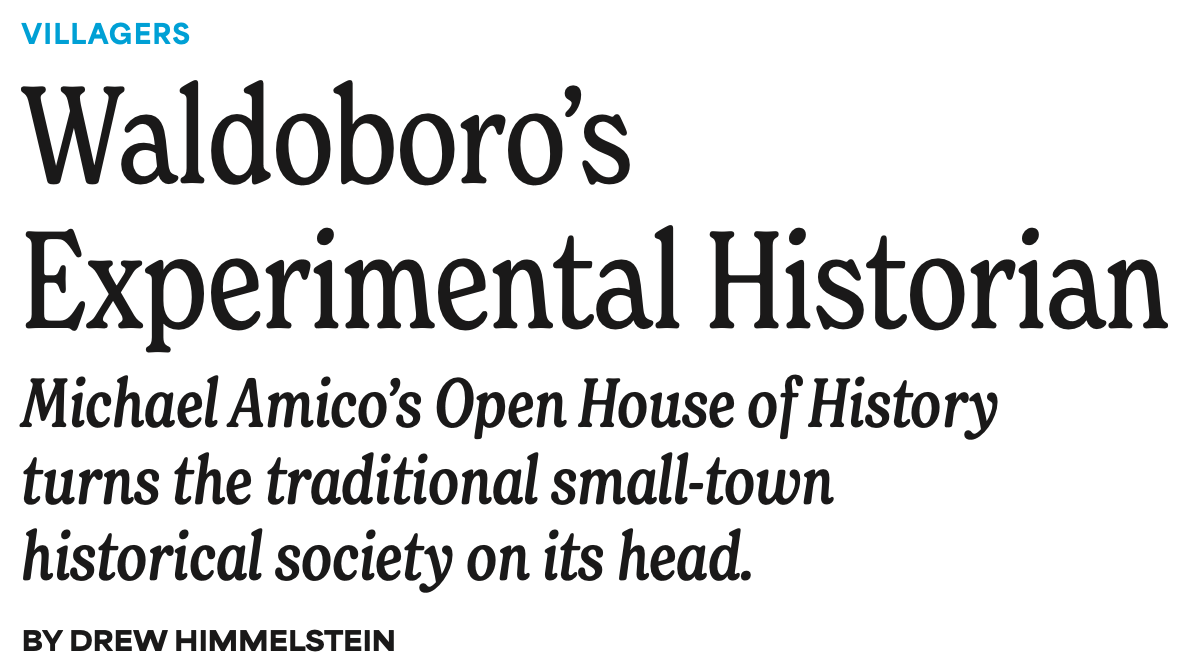
Michael Amico, founder and director of Open House of History, stands before a wall of Lincoln County maps in “Entering the Feelscape of Time,” an installation on the upper level of the Custom House in Waldoboro July 28. PHOTO BY JOHN BLODGETT [Amico] turned the [Custom House] into the Open House of History, seeking to engage the community in Waldoboro’s history by mapping it onto emotional experience. “What interests me most is how people come to emotionally affect other people,” he said. “It’s my attempt to answer the related question of how change actually happens.”
That’s because, as Amico sees it, people and society change not through persuasion by reasoned argument, but through emotional experiences. He calls it the “feelscape of time,” and it’s the driving force of his work.
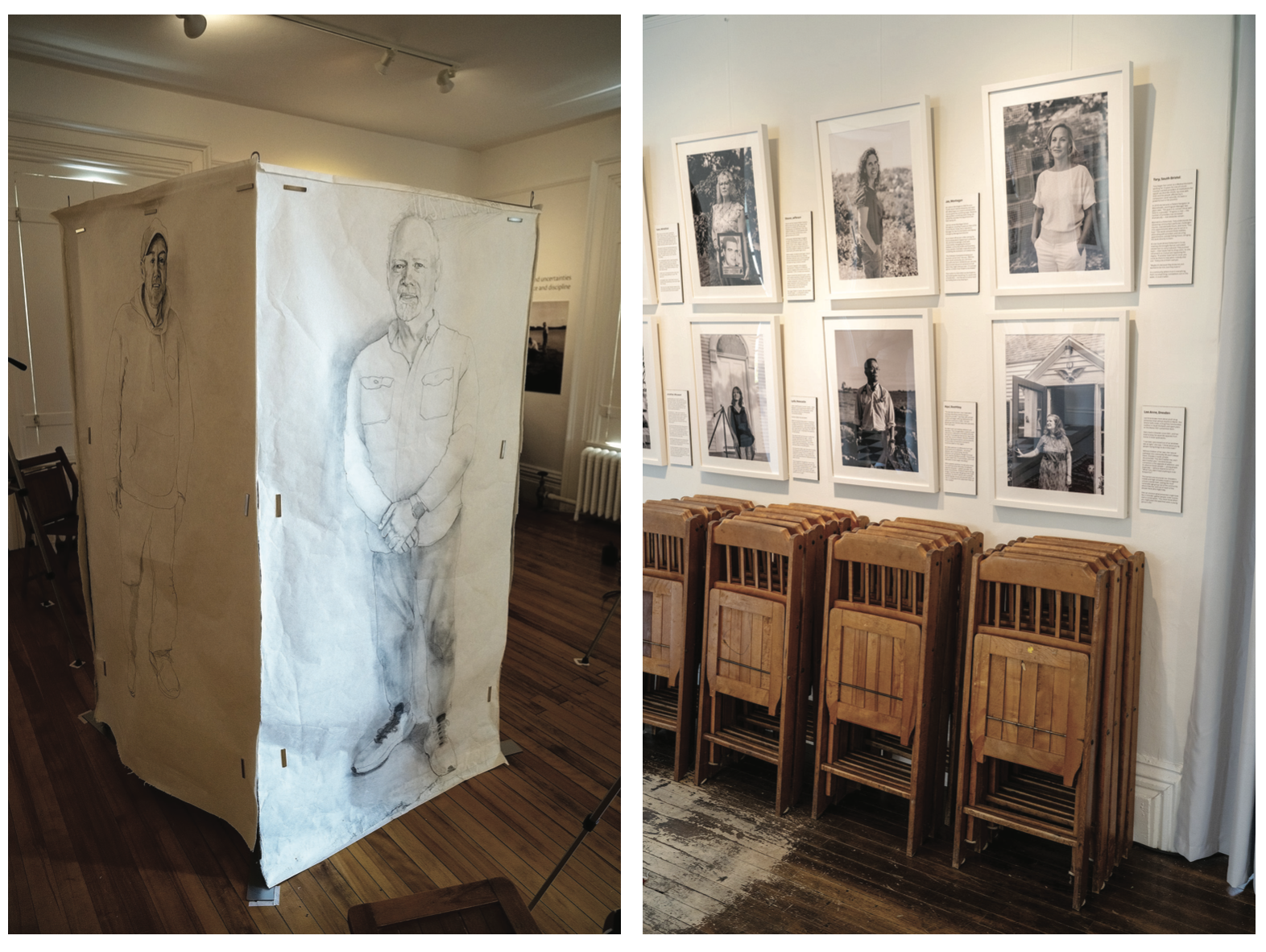
Hand-drawn portraits of local watermen by artist Jan Arabas hang as part of "Entering the Feelscape of Time," an Open House of History installation on the upper level of the Custom House in Waldoboro July 28. Arabas' portraits depict people who work on the water, part of a larger multi-sensory exhibition exploring the labor, uncertainty and resilience of lobstermen, shellfish harvesters and community scientists.
PHOTO BY JOHN BLODGETT
Framed black-and-white portraits by Hannah Latham from the Open House of History exhibition "19 Towns, 20 Stories" hang on a wall above a row of stacked wooden folding chairs at the Custom House in Waldoboro July 28. The exhibition, with narratives by Leigh Perkins and Peter Bruun, tells one person's story from each of Lincoln County's 19 towns, plus the experience of an unhoused individual, addressing substance use disorder in rural communities. PHOTO BY JOHN BLODGETT“Public discourse has quickly and loudly returned to familiar patterns of good guy versus bad guy,” he said. “Once again, we sort people into moral camps and then rationalize our judgments.”
By setting up shop in the Custom House, Amico has developed the Open House of History into an experiential space in which visitors can step into the past. He says he’s merely returning the building to its original use as a civic space where people from different backgrounds can cross paths and engage in community life.
Amico cites theatrical influences on his approach to history that range from performance art to the big, dramatic spectacles of Greek theater and Wagnerian operas. He is also influenced by another setting in which people lay bare human emotions in front of each other: group therapy. It’s a practice in which, he explains, you connect intimately with people in a therapeutic setting whom you don’t know in everyday life.
“I feel like a lot of what I’m doing in town is trying to find a way to stage a kind of collective therapeutic process,” he said.
Amico has no shortage of future material. After all, history is long.
"I think it’s about trying to conjure the ghosts, the spirits of those people."

Podcast interview from Lincoln County News
Starting at minute 13:40, LCN general assignment reporter Molly Rains sits down with Michael Amico to talk about the Open House of History and how he hopes to foster learning opportunities through the organization's programming.


A banner on the balcony of the former Custom House in Waldoboro welcomes visitors to new nonprofit Open House of History, where founder Michael Amico hopes to inspire empathy and discovery through exploration of the greater community’s shared history and emotions. (Molly Rains photo)“A new era is unfolding at the storied Waldoboro Custom House.
Though the events that Open House of History facilitates are diverse, they are all intended to help community members understand themselves, their town, and their neighbors in new ways with history as their guide, according to Amico.
Traditionally, people tend to come together in community around shared interests, Amico said. Inevitably, this can lead to exclusion and group-think, both of which Amico considers counterproductive to dialogue. At Open House of History, Amico hopes to bring visitors together over something more universal: the emotions all people experience and share. ‘People already share emotion,’ he said. ‘We just don’t have a means or a language to talk about it, and certainly not a space.’ The Custom House will create that space, Amico hopes.”

Michael Amico delivers a talk on local educational pioneer Harriett Haskell at the former Waldoboro Custom House in Waldoboro on June 29. The building is now home to Amico’s nonprofit, Open House of History, through which he hopes to bring the past and present into conversation and unite locals over shared emotionality. (Sarah Masters photo)“Amico wants the new space to encourage visitors to be present and sit with their emotions, particularly with the difficult feeling of uncertainty. He hopes community members will find opportunities at the house’s events to get to know each other, which often, he said, means acknowledging how little people know about their neighbors.
Amico’s journey to founding the nonprofit and articulating its mission has unfolded naturally, if unexpectedly at times, he said. So far, the work has been gratifying.
‘It feels right, but I never thought it would appear this way,’ he said.”
Read the Full Article in The Lincoln County News, August 3, 2025

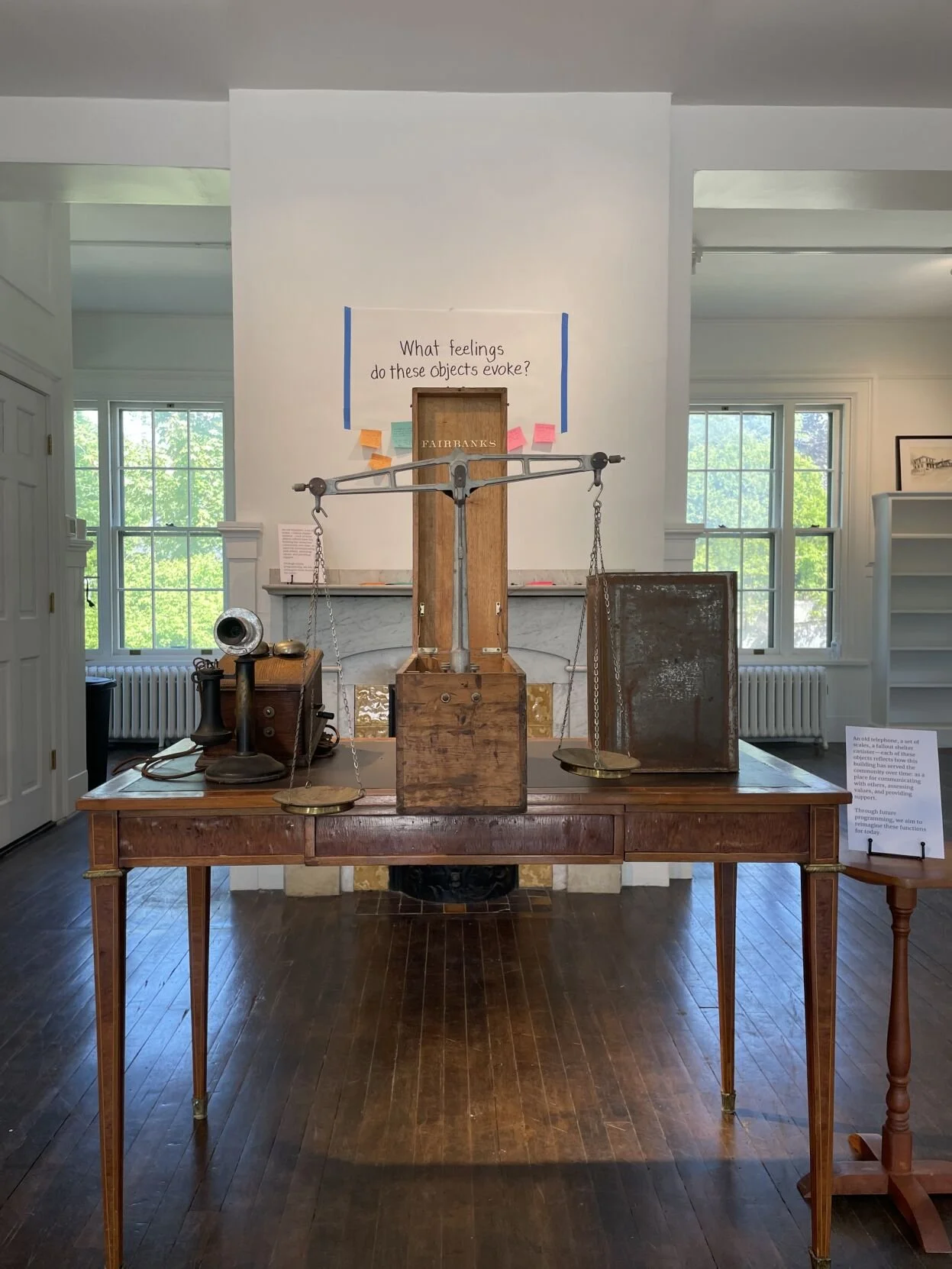
Historical objects on display at the Customs House in Waldoboro. “… asks not only what Waldoboro can and should be as a community — but also how the community might shape the Open House of History itself. … For the initial event held under the auspices of the Open House of History, Amico staged objects in the old Custom House … that are on loan from the Waldoborough Historical Society, and posed a series of questions alongside them. What feelings do these objects evoke? What issues should Waldoboro discuss as a community? What are Waldoboro’s challenges? Its opportunities?
The objects are very deliberately selected; on the first floor, there’s an old telephone, a set of scales, and an old tin of rations, which speak to the different roles the Custom House has played throughout the centuries — including when it was designated as a fallout shelter during the Cold War. Now, Amico wants to give the building back to a community, and see what else it can be.”